The Original Food Truck Rodeo
Walk through any major American city today and you'll witness a familiar dance: food trucks circling blocks like urban sharks, dodging parking enforcement while slinging tacos to office workers who've grown tired of $15 salads. Meanwhile, City Hall churns out new regulations—licensing requirements, health codes, distance restrictions from brick-and-mortar restaurants—in an endless cycle of bureaucratic cat-and-mouse.
This exact scenario played out in ancient Rome, down to the smallest details. The only difference? Instead of trucks, Roman street vendors operated from thermopolia—small shops with openings onto busy streets where they sold hot food to the urban masses. And instead of modern health departments, Roman authorities spent centuries trying to control, tax, or eliminate these vendors using arguments that would sound completely familiar to anyone who's followed a contemporary food truck controversy.
When Street Food Was a Fire Hazard
Roman authorities had legitimate safety concerns. Thermopolia operators cooked over open flames in wooden structures packed into narrow streets. The Great Fire of 64 AD, which destroyed much of Rome, started in shops exactly like these. Emperor Nero's response was predictably bureaucratic—he banned cooking in residential areas and required all food vendors to obtain permits from city officials.
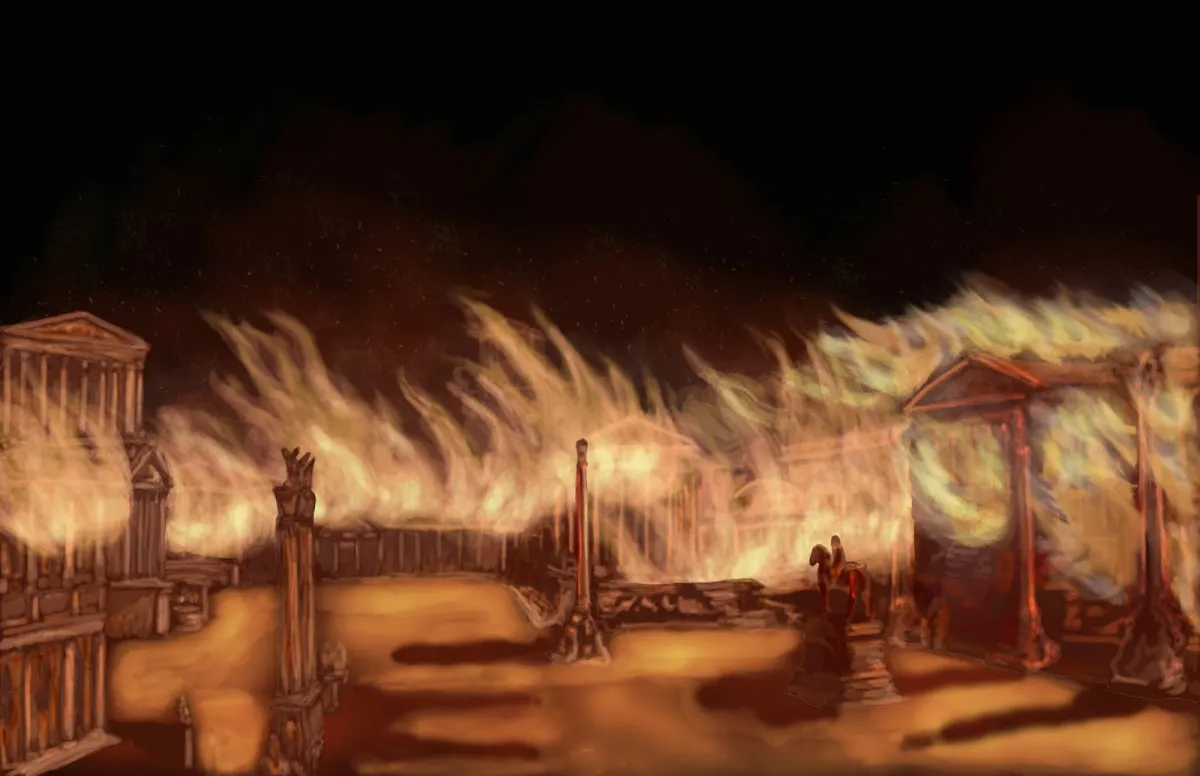 Photo: Great Fire of 64 AD, via 3.bp.blogspot.com
Sound familiar? Modern food trucks face similar safety theater. Cities require expensive commercial kitchen certifications, mandate specific fire suppression systems, and impose elaborate permitting processes that often seem designed more to limit competition than ensure safety. The underlying dynamic is identical: legitimate safety concerns become pretexts for controlling an informal economy that threatens established interests.
Roman shop owners complained that thermopolia were "unfair competition"—they didn't pay the same rents, weren't subject to the same regulations, and could relocate if business got slow. Their modern counterparts, restaurant owners, make exactly the same arguments about food trucks. The economic logic hasn't changed: mobile vendors have lower overhead costs and greater flexibility, advantages that established businesses want regulated away.
The Moral Panic About Fast Food
But Roman authorities weren't just worried about fires and competition—they were concerned about social order. Thermopolia attracted exactly the kind of crowds that made elite Romans nervous: day laborers, slaves, freedmen, and other working-class Romans who couldn't afford to eat at home.
Roman writers like Seneca complained that these food stalls encouraged laziness and moral decay. Why should workers go home to their families when they could grab cheap meals on the street? Why should wives cook when husbands could eat out? The thermopolia, critics argued, were destroying traditional Roman family values by making it too easy for people to avoid their domestic responsibilities.
This moral dimension of food policy has never disappeared. Modern critics of fast food and food trucks deploy remarkably similar arguments—that cheap, convenient meals are somehow corrupting American values, encouraging laziness, and undermining family dinners. The target has shifted from Roman paterfamilias authority to nuclear family ideals, but the underlying anxiety about food choices as moral choices remains constant.
Licensing as Control
Roman authorities eventually settled on a licensing system that should sound familiar to anyone who's tried to operate a food truck in San Francisco or New York. Thermopolia operators needed permits from multiple government offices, had to pay annual fees, and were subject to random inspections. The system was complex enough that only vendors with political connections or significant capital could navigate it successfully.
This wasn't accidental. Complex licensing serves the same function in every era—it filters out small operators while protecting established players who can afford compliance costs. Roman authorities weren't trying to eliminate street food entirely; they were trying to control who could sell it and where.
Modern food truck regulations follow the same playbook. Expensive permits, complex health codes, and arcane parking restrictions don't eliminate street food—they just ensure that only well-capitalized operators can afford to play the game. The mom-and-pop vendors who made thermopolia affordable and accessible get priced out, just as they were in ancient Rome.
The Geography of Enforcement
Roman enforcement was predictably uneven. Thermopolia in wealthy neighborhoods faced constant harassment, while those in working-class areas operated with relative freedom. Vendors who paid bribes to the right officials could operate anywhere; those without connections found themselves constantly moving to avoid fines.
This selective enforcement pattern persists in every modern city. Food trucks in business districts face aggressive ticketing, while those in industrial areas operate unmolested. Vendors with political connections get prime spots outside government buildings; newcomers get chased from corner to corner by parking enforcement.
The underlying logic is always the same: street food is fine as long as it stays in its place and doesn't threaten the wrong interests. The geography of power determines the geography of enforcement.
Why Street Food Always Survives
Despite centuries of regulation, taxation, and occasional outright bans, Roman street food never disappeared. The economic logic was too compelling: urban workers needed cheap, fast meals, and entrepreneurs would always emerge to meet that demand. Every attempt to eliminate thermopolia just drove them into different neighborhoods or created new workarounds.
Modern food trucks demonstrate the same resilience. No amount of regulation has eliminated them because they serve a genuine economic need that established restaurants can't or won't meet. Food trucks provide affordable meals to workers who can't afford $20 lunch entrees, and they do it faster and more conveniently than traditional restaurants.
The Eternal Return of the Same Fights
The next time you see a news story about food truck regulations—permits, health codes, distance requirements, or parking restrictions—remember that you're witnessing the latest chapter in humanity's oldest urban conflict. The vehicles may have evolved from handcarts to motorized trucks, but the essential dynamic remains unchanged: informal food economies versus institutional control, convenience versus regulation, economic opportunity versus established interests.
Roman thermopolia operators would recognize every argument in a modern City Council food truck hearing. The only thing that's changed is the technology—the politics, economics, and social anxieties are exactly the same as they were 2,000 years ago.