The Tip Jar Is Someone Else's Wage Bill
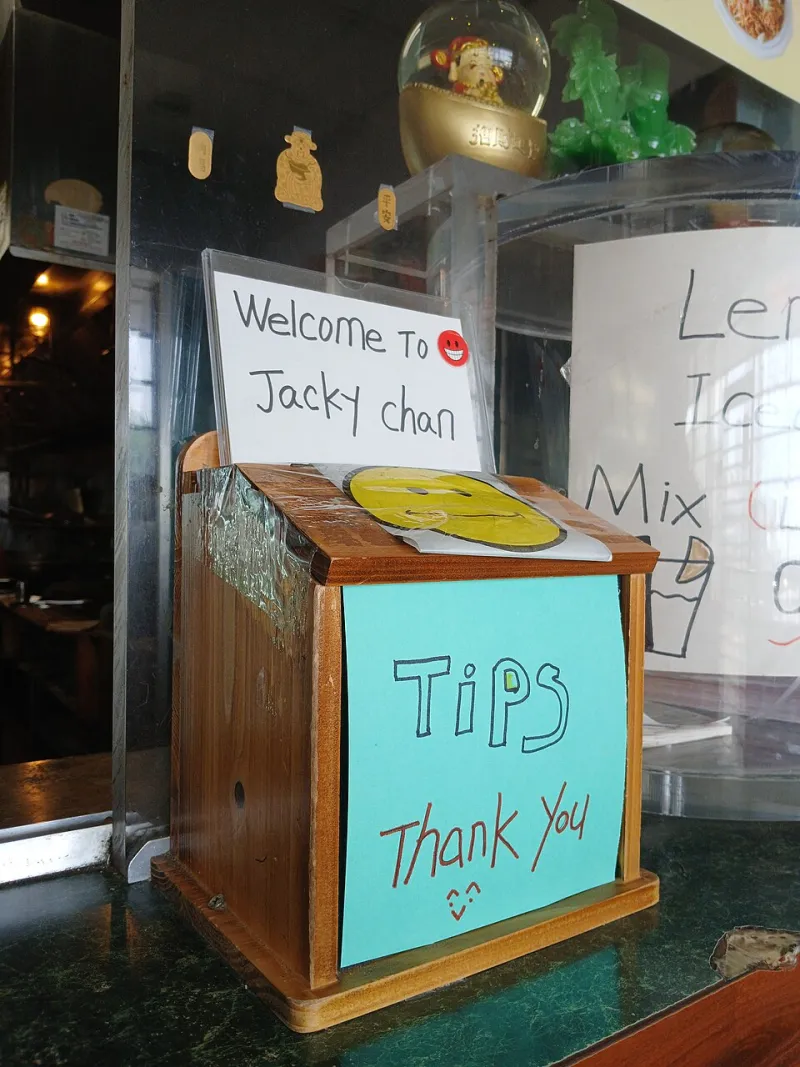
Photo: Ser Amantio di Nicolao, CC BY-SA 4.0, via Wikimedia Commons
The Tip Jar Is Someone Else's Wage Bill
Somewhere right now, an American is standing at a tablet checkout screen, watching a tip prompt rotate through 18%, 20%, and 25% for a transaction that involved someone handing them a bag. They're doing the social math — who's watching, what does declining say about them, is $2 going to ruin someone's night — and they're probably going to tap 20% to make the screen go away.
This is not generosity. It is the successful execution of a century-old cost-shifting strategy that neither party fully understands.
Where Tipping Actually Came From
The origin story of tipping is not, as many Americans assume, some organic expression of appreciation that evolved naturally from good service. It's a class performance imported wholesale from European aristocracy.
In 16th and 17th century England, wealthy guests staying at private homes would leave small sums of money for the household servants — people who were technically employed by the host, not the guest, but who had performed personal services during the visit. The payment was called a vail, and it was explicitly a demonstration of the guest's status. You tipped because you could, and because it announced that you moved in circles where such gestures were expected. It was conspicuous generosity as social credential.
The practice migrated into taverns and inns as a way for aristocratic travelers to distinguish themselves from common customers. You tipped the innkeeper's staff not because they needed it particularly, but because tipping was what people of quality did. The message wasn't thank you. It was note that I am the kind of person who does this.
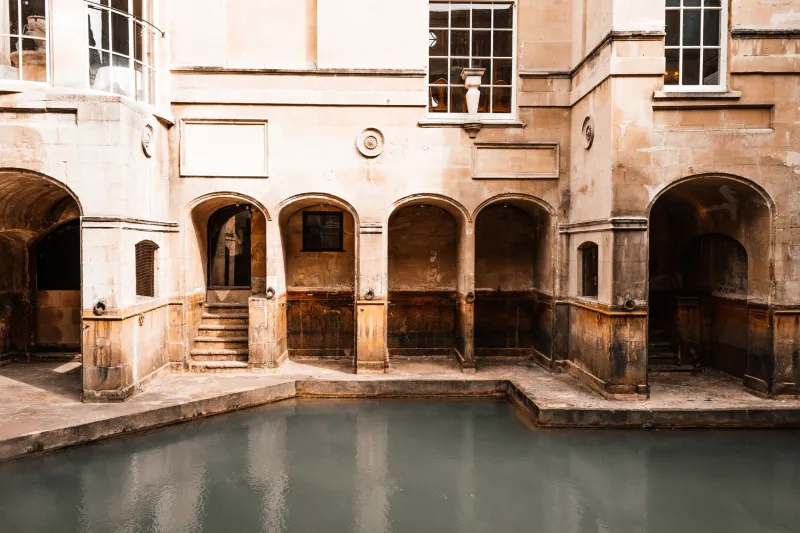
Roman tavern culture had its own version, though less formalized. Thermopolia — the fast-food counters that lined Roman streets — operated on a cash economy where regulars cultivated relationships with servers through small gifts and extra payments. Innkeepers along Roman roads ran essentially the same hustle that roadside hospitality has always run: the service was technically included, but the people who made it comfortable expected something extra, and the smart traveler understood that.
The psychology hasn't changed. Only the mechanism.
America Initially Told Tipping to Get Out
When tipping arrived in the United States in the late 19th century, carried back by Americans who'd traveled to Europe and wanted to import the custom, it ran into genuine resistance. Not from workers — from customers and civic reformers who saw it as fundamentally anti-American.
The argument was straightforward: tipping created a two-tier service system where wealthy customers got better treatment, it introduced an arbitrary and humiliating element of supplication into what should be a straightforward commercial transaction, and it was frankly aristocratic in a country that had supposedly rejected aristocracy. The Anti-Tipping Society of America, founded in 1904, had chapters in several states and actual political traction. Six states briefly banned tipping outright in the early 1900s.
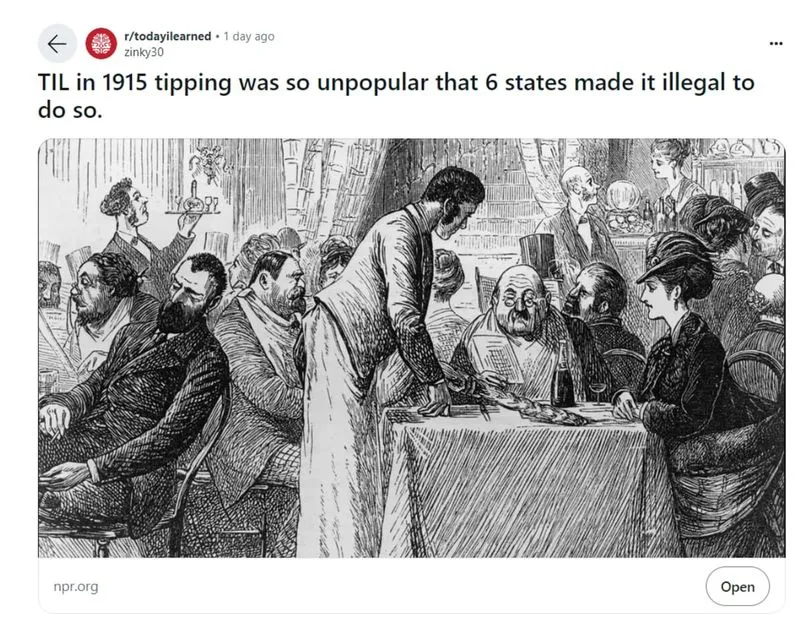 Photo: Anti-Tipping Society of America, via backintimetoday.com
The reformers lost, and the reason they lost is where the story gets economically interesting.
The Moment Employers Figured Out the Angle
The tipping abolition movement collapsed for two interconnected reasons. First, Prohibition. When alcohol revenue disappeared from restaurants and bars, owners needed to cut labor costs dramatically, and tipping offered a convenient mechanism. Second, and more structurally, employers realized that the existence of tips gave them a legal and social justification for paying servers almost nothing in base wages.
If customers were going to compensate workers directly for good service, the argument went, then the employer's wage obligation was reduced. This logic got baked into American labor law in 1938 when the Fair Labor Standards Act established a separate, lower minimum wage for tipped workers. That lower wage has barely moved since. The federal tipped minimum wage has been $2.13 an hour since 1991 — thirty-plus years frozen — on the explicit assumption that tips will make up the difference.
The assumption transfers the wage bill from the employer to the customer. Not partially. Almost entirely. The restaurant owner sets the price of the meal, pockets the margin, and relies on social pressure to ensure the customer also pays the staff. It's a genuinely elegant piece of cost engineering, and it was not an accident.
Ancient guild structures pulled similar moves. Medieval innkeepers and tavern operators in Europe paid their serving staff at the lower end of subsistence and relied on the understood custom of guest gratuities to keep workers from leaving. The employer got the labor at discount; the customer got the tab for keeping it functional. The framing was generosity. The mechanism was wage suppression.
Why the Tip Prompt Keeps Growing
The expansion of tipping in the past decade — from restaurants into coffee shops, food trucks, airport kiosks, and now essentially any point-of-sale terminal that can display a rotating wheel of guilt — isn't a cultural accident. It's the predictable result of technology making it cheaper and easier to present tip requests, combined with the same underlying logic that created tipping in the first place: somebody else's labor cost becomes your social obligation.
The tablet checkout tip prompt is particularly well-designed from a behavioral economics standpoint. It presents three pre-set options, all of which are tips, making the zero-tip option feel like an active hostile choice rather than a neutral one. It appears at the moment of maximum social visibility — other people in line, the worker right there — and it uses the same status signaling that made tipping attractive to 17th century English aristocrats. Declining feels cheap. Tapping 20% feels like being a decent person.
What it actually is, in most of these contexts, is a business transferring its payroll responsibility to its customers through an interface designed to make refusal uncomfortable.
The House Always Wins This One
None of this means individual servers don't need tips, or that the people working hospitality jobs don't deserve more money. They do. That's precisely the problem. The system has been running long enough that workers are now genuinely dependent on a mechanism that was designed to underpay them.
The solution that comes up periodically — just pay workers a real wage and price the service accordingly — is how most of the world operates. Most European countries, Australia, Japan: service-included pricing, living wages, no guilt tablet. The food costs a little more on the menu. Nobody does social math at checkout.
America tried that argument in 1904 and lost it to restaurant owners who saw a better deal. The five-thousand-year track record of hospitality economics is pretty clear on this: when employers can make customers pay their workers, employers will make customers pay their workers. The only variable is how the ask gets dressed up.
Right now it's dressed up as a touchscreen with three numbers and a skip button that feels vaguely shameful to press. Earlier versions used silver trays and expectant silence.
The psychology is identical. The tab just looks different.